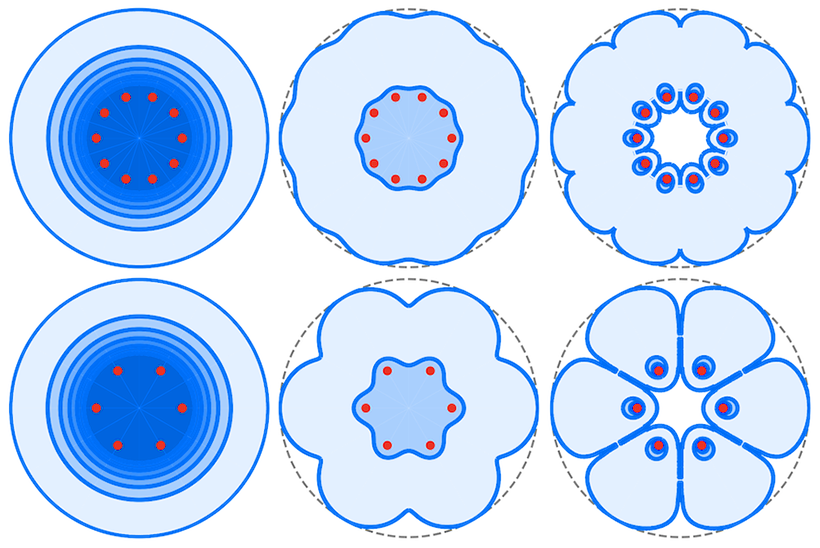
Carbon capture and storage must play a central part of the decarbonisation of the energy system, and researchers at the Institute has been working on carbon storage for over 15 years, exploring the control of CO2 in subsurface saline aquifers.
A new research paper has just been published in the Journal of Fluid Mechanics, and illustrates the work of PhD student Ross Shepherd, supervised by professor Andy Woods. In this paper, Ross and Andy use a numerical model to explore the spreading of a CO2 plume from a series of injection wells arranged around the crest of an axisymmetric anticline structure connected to an aquifer.
For a constant CO2 injection rate, they calculate both the fraction of available pore space in the anticline filled by structurally-trapped CO2 and the maximum pressure within the anticline throughout the injection process. The model shows that the fraction of the anticline filled with CO2 varies considerably between slow, buoyancy-controlled filling and fast, pressure-controlled filling, with the latter case leading to much smaller fractions of the anticline accessed by the CO2 plume. The article also shows that there is a correspondence between the maximum pressure within the anticline produced by a single injection well at the centre and the maximum pressure produced by a series of equally spaced injection wells.
You can read the full article here, and find out more about the Institute’s work on carbon storage here.