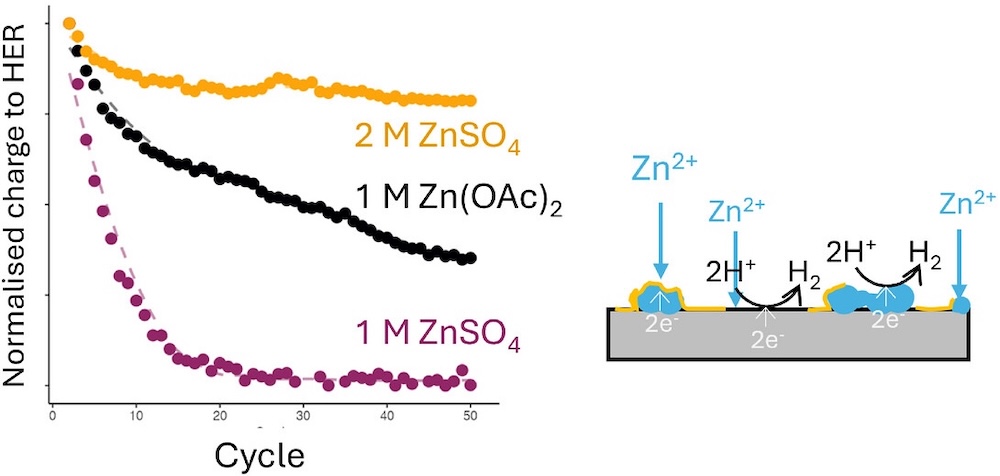
The performance of Zn metal batteries is limited by the parasitic hydrogen evolution reaction (HER), which occurs at potentials similar to Zn plating. The HER contributes to losses in coulombic efficiency and causes passivation via local pH changes, resulting in by-product formation on the electrode surface. Understanding these processes is essential for controlling Zn morphology and improving the lifetime and safety of ZMBs.
A new research paper, recently published in Advanced Energy Materials and co-authored by professor Stuart Clarke uses scanning electrochemical microscopy (SECM) to quantify hydrogen evolution by monitoring the hydrogen oxidation reaction at an ultramicroelectrode during electrode cycling. The article demonstrates, across a series of battery-relevant electrolytes, that hydrogen evolution decreases upon cycling because of changes in Zn crystallinity and by-product formation, as supported by in-situ Raman spectroscopy and X-ray diffraction. Using the generation and collection modes of SECM, the authors quantify the contribution of HER to charge passed during Zn electroplating and show that, under the present conditions, it is orders of magnitude smaller than irreversible charge losses inferred from Coulombic efficiency measurements. These findings establish SECM as a powerful operando method for decoupling HER from other degradation pathways in aqueous Zn electrolytes.