Martin Blunt is the Professor of Flow in Porous Media at Imperial College, London. Some of his research work focusses on the flows in underground sedimentary rocks: this is where oil and gas are traditionally found, but is also where we must now look to store carbon dioxide, hydrogen, and thermal energy.
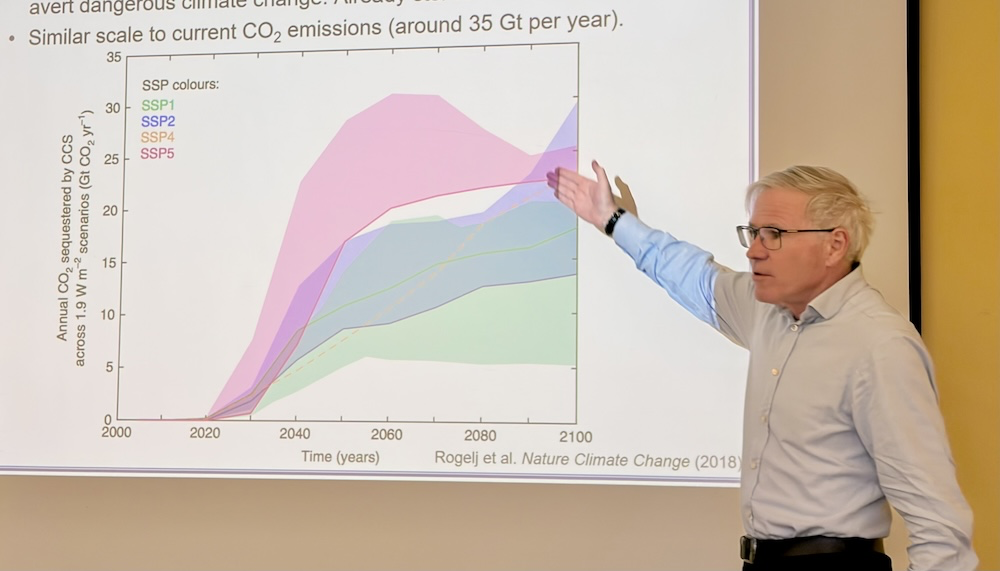
Safely storing large volumes of carbon dioxide in underground formations will be a crucial engineering challenge in the coming decades. To prevent global temperatures from rising more than 2oC, up to 30 Gt of carbon dioxide will need to be captured and stored annually by the middle of this century. For comparison, current global emissions are of order 35 Gt CO2 per year, and current storage rates are only about 45 Mt CO2 per year.
To investigate how CO2 flows through a porous rock, Professor Blunt and his research team have been using laboratory experiments and advanced imaging technologies, including SEM, X-rays and synchrotron imaging. Using these technologies, it is possible to capture high-speed, three-dimensional images of the flow at reservoir conditions and observe the movement of fluids through the pore spaces in real-time with about 1s time resolution.
The data collected during the laboratory experiments suggest that capillary trapping is the most rapid method for immobilising carbon dioxide underground. In multiphase systems where carbon dioxide is present in the field alongside water and oil, the relative wettability of the different phases controls the large-scale properties of the flow.
You can read more about the work done by Professor Blunt and his team at Imperial here. The professor has also curated a series of lectures on reservoir engineering and flow in porous media, which are freely available online here.