The surface of old paintings often exhibits a series of cracks, reminiscent of the cracks which develop on parched ground during a drought. In both cases, the cracks develop over time as a result of surface desiccation.
In fact, the evaporation of the solvent from a film of a colloidal suspension induces the formation of a deposit of close-packed particles. As the evaporation continues, this deposit may fracture into a diversity of patterns, depending on the properties of the suspension, on the shape and thickness of the deposit and on the evaporation rate.
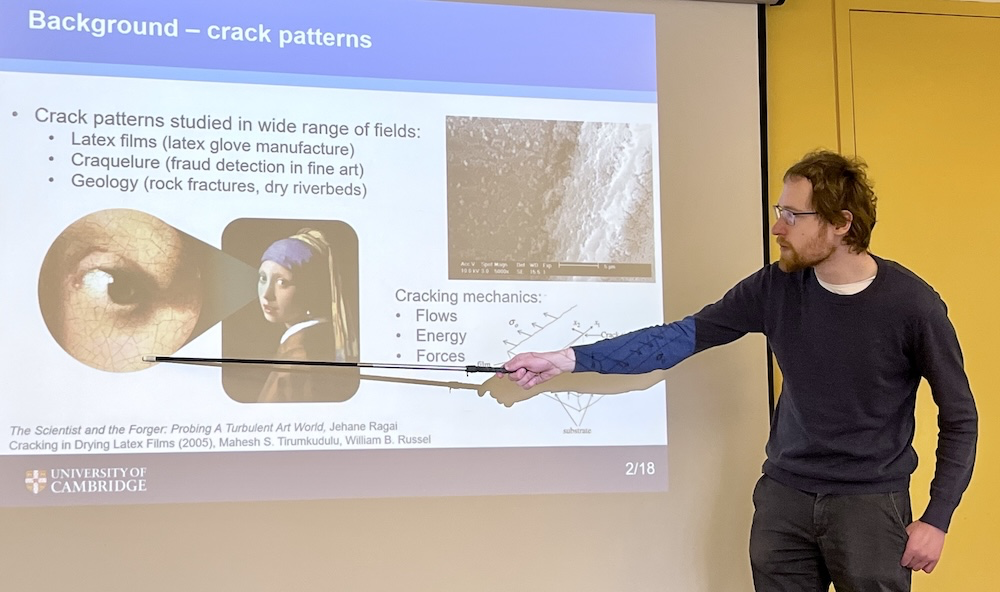
Professor Alex Routh and his group have been working for years on film cracking, and today PhD student Nicholas Mackay presented some of the most recent results of his work on crack pattern detection in dried colloidal films.
Nicholas uses advanced image analysis to detect and characterise the pattern of cracks which develop when a thin layer of a latex suspension is left drying in controlled conditions. Nicholas work is ongoing, and it builds on the previous work by Dr Sheila Bhatt on pattern formation in drying blood droplets.
Just like oil paint and wet soil, blood is also a dispersion of particles (red blood cells) in a liquid. When a drop of blood is left drying on a surface, the liquid evaporates and the pattern of cracks forming on the remaining deposit is controlled by the properties of the red blood cells.
There are a number of medical conditions, including anaemia, hyperlipemeia, jaundice and others, which affect the properties of red blood cells. Hence, observing the pattern of cracks which form in drying blood droplets has potential to be used for diagnostics.