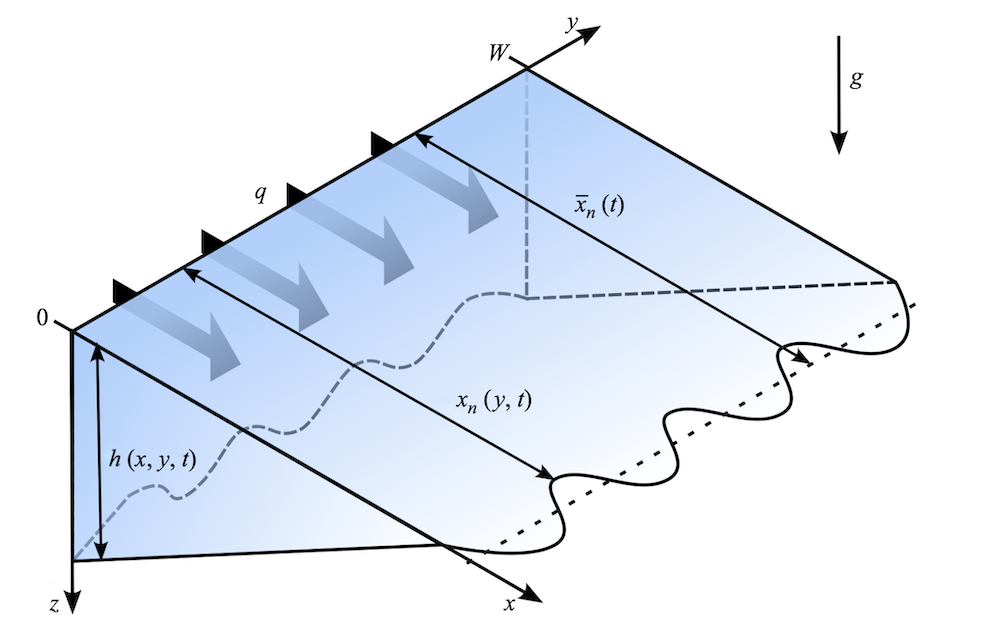
One of the challenges with modelling subsurface flows is the uncertainty in measurements of geological properties, mostly due to limited resolution in observation methods. Typically, the observations of subsurface systems have a resolution of order 1 m, and this leaves a large amount of uncertainty in the small-scale variation in properties such as permeability.
Many geological flows, such as those associated with underground carbon storage and groundwater flows, can be modelled as gravity currents. A new paper by PhD student Emily Flicos and professor Jerome Neufeld models the uncertainty in permeability as a periodic perturbation to a mean value. This induces a perturbation in the flow of a gravity current through the porous medium.
In their recent article, Emily and Jerome show that there are distinct early and late regimes for both single- and multi-modal permeability perturbations. At early times, the height and nose position of the current are determined by the local permeability, and deviations to the height and nose grow at the same rate as the mean, and proportional to the amplitude, of the permeability variation. At late times, however, lateral spreading between high and low permeability streaks is dominant. Consequently, the height deviations decay and the nose deviations approach a steady state. The magnitudes of both depend on the product of the wavelength and amplitude of the permeability.
This article has been recently published in the Journal of Fluid Mechanics, and is available here.