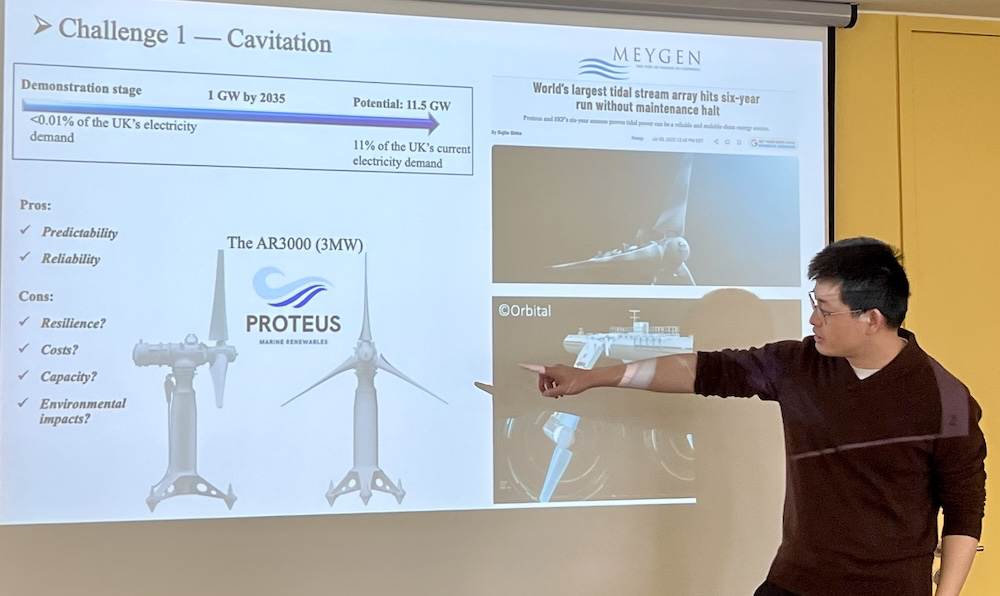
Wind energy supplied approximately 30% of UK electricity in 2025, underscoring its central role in the energy transition. Tidal power, though still at the demonstration stage, has the potential to meet up to 11% of annual UK electricity demand. However, key fluid dynamic challenges continue to limit the performance, scalability, and environmental acceptability of turbine technologies.
In wind farms, turbine wakes reduce downstream power output by 20-46% due to persistent tip vortices and slow wake recovery. In tidal turbines, vortex-induced cavitation constrains operation at high tip-speed ratios, limiting efficiency and power capacity. These same tip vortices are also a primary source of aerodynamic and hydrodynamic noise, which affects environmental impact, regulatory approval, and public acceptance of turbines.
Dr Yabin Liu, from the Department of Engineering, has been developing passive control strategies that address these vortex-driven limitations. Using CFD simulations, he has demonstrated that introducing a layer of material with increased permeability near the tip of a turbine blade accelerates the breakdown of the vortex. This reduces the vortex strength and mitigates the risks associated with cavitation while promoting faster wake recovery.
Rapid wake recovery is essential in wind farms: since power output scales with the cube of the flow speed, even small increases in the speed of the fluid in the wake of a turbine make for significant increases in the amount of energy harvested by any additional turbine downstream. Yabin’s model currently estimates that adding permeable wing tips to an upstream turbine could increase the power output of downstream turbines by up to 12%.
You can read more about Yabin’s passive turbine wing design here and here. Yabin is currently collaborating with TU Delft and Tokyo University of Agriculture and Technology to investigate the impacts of this design on the noise generated by the turbine, and we look forward to hearing about his new experiments soon.