We are all familiar with the “fresh paint smell” that characterises rooms that have been recently re-decorated. This smell is often due to chemical additives, which are added to the paint to make it more flexible, durable, and resistant to cracking or peeling. There are environmental and health concerns associated with these additives and so the industry is trying to reduce use of these volatile organic compounds. This risks making paint layers more fragile and brittle. Hence, understanding the different processes that occur as paint dries becomes essential to avoid the formation of cracks.
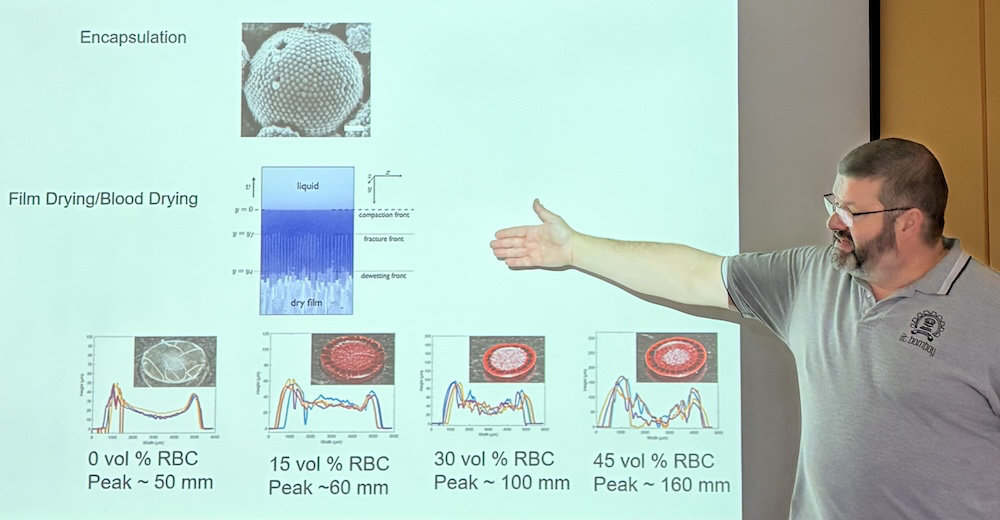
When a surface is covered with a layer of paint or coating, an aqueous dispersion of polymer particles is initially deposited onto the surface. As the paint dries, water is gradually removed from this suspension by evaporation and the particles are increasingly packed together and deformed. Eventually, a process of interdiffusion occurs, where polymer chains cross the boundaries between the deformed particles. As a result of this process, the particles become entangled with one another and form a continuous, dry film onto the surface.
Professor Alex Routh has been studying the different mechanisms that drive the particle deformation process during film drying. As water progressively evaporates from the surface, the particles experience changes in surface tension and capillary forces, leading to different responses, depending on factors like temperature, particle size, and evaporation rate.
During today’s seminar, Professor Routh showed that film formation is a complex process governed by a balance of thermodynamic and mechanical forces. Understanding these forces is essential for designing better coatings. You can read more about this topic in a book co-authored by the professor, as well as in the Research group page on the new website of the Department of Chemical Engineering and Biotechnology.