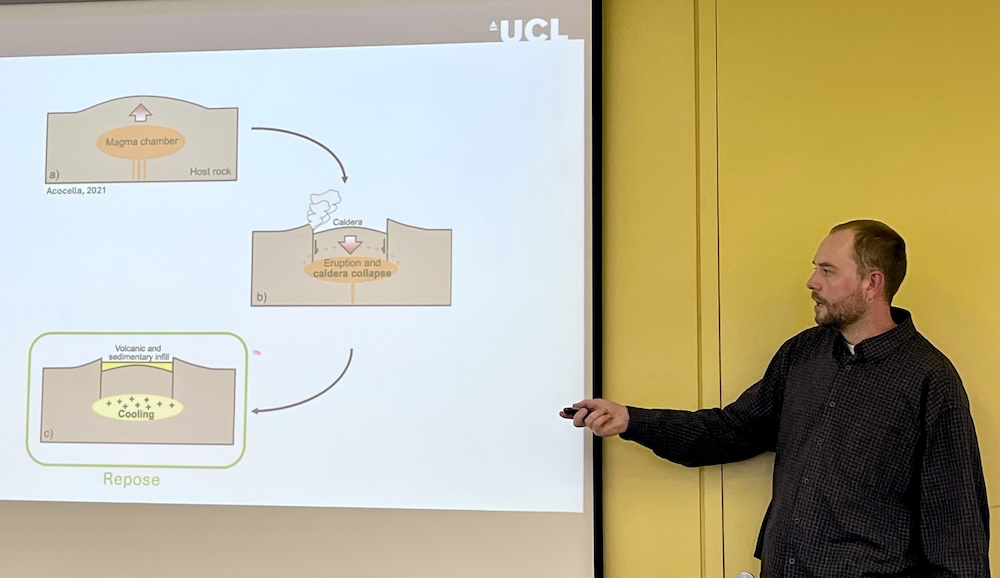
Volcanic eruptions threaten more than one in ten people worldwide, with the greatest risk at volcanoes reawakening after long quiescence. In these settings, eruptions are often explosive and nearby communities may be unprepared.
After obtaining his PhD at IEEF, Dr Eric Newland has been working on the NERC-funded project “FEVER: Forecasting Eruptions at Volcanoes after Extended Repose” in the Hazard Centre at UCL. Eric’s research focusses on the physical processes that control the approach to eruption at volcanoes that have been silent for generations, by relating patterns of precursory signals of an eruption, such as seismicity and ground deformation, to processes for creating new pathways for magma ascent.
Unrest at volcanic sites commonly reflects magma accumulating in shallow storage, deforming the surrounding crust until it fails; a magma-filled fracture can then propagate to the surface and trigger an eruption. Forecasting such events therefore depends on tracking deformation and estimating when the crust will rupture.
Eric has studied the seismic activity which preceded the 2018 Sierra Negra eruption in the Galápagos Islands, and compared it to the seismic activity which has been developing since 2011 in the Campi Flegrei region near Naples, Italy. Both events appear to follow a characteristic sequence: an initial linear increase consistent with predominantly elastic deformation of the crust, followed by a transition to inelastic behaviour as energy loss to fracturing rises and ultimately exceeds the elastic energy input. Thereafter, the mean stress declines, indicating progressive weakening driven by seismicity-induced damage. This pattern mirrors laboratory observations and is consistent with the development of new pathways for magma and fluids.
Work on eruption forecasting is ongoing at the UCL Hazard Centre, and you can read more about it here.