Modelling the deep ocean at high resolution: vortices, tracer transport and mixing

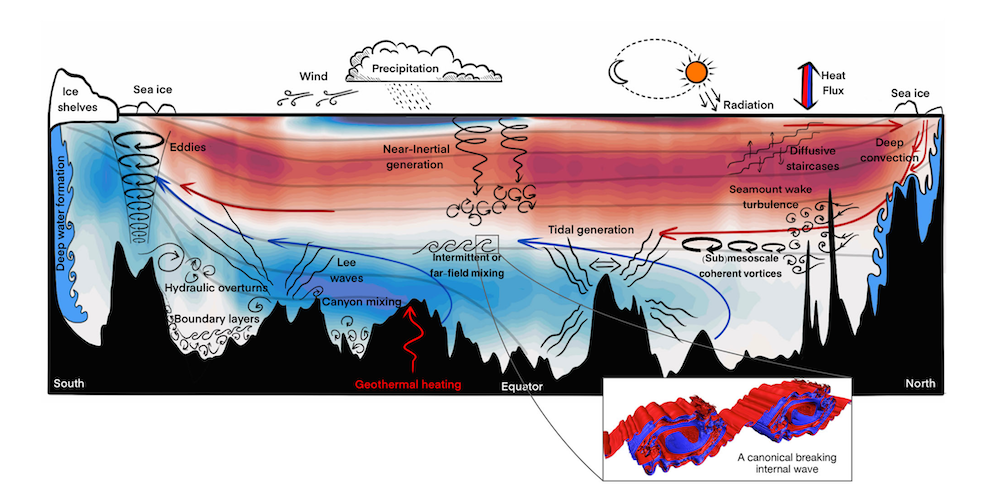
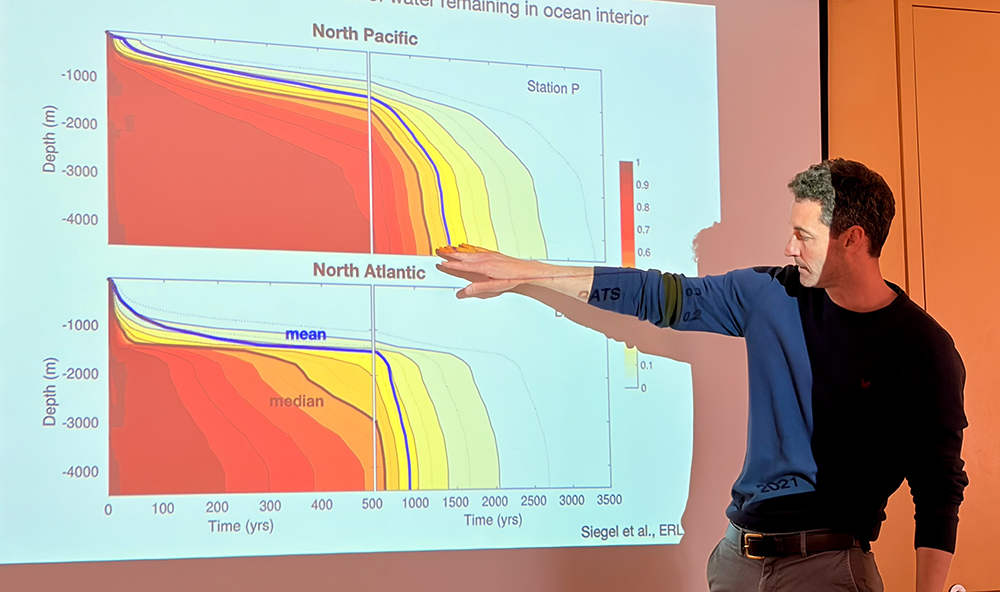
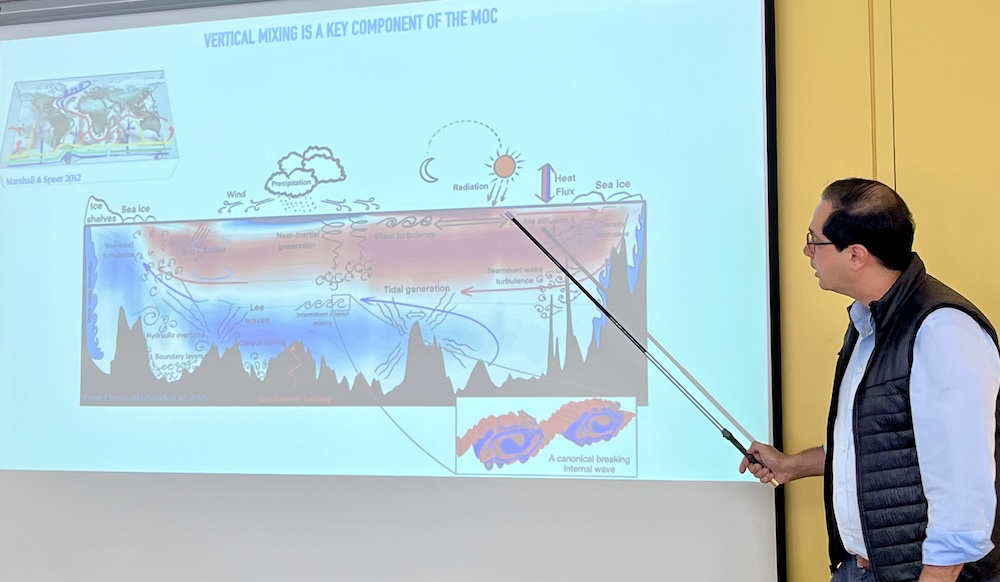
Numerical modelling is a key tool for understanding deep ocean dynamics, where observations remain sparse, particularly at submesoscales (1–30 km). Jonathan Gula, from the Laboratoire d’Océanographie Physique et Spatiale, Université de Bretagne Occidentale, uses high-resolution basin-scale and regional simulations to investigate how interactions between currents, topography, and mixing shape abyssal circulation and tracer transport. During

Atlantic Ocean water mass classification from machine learning

Water masses are large bodies of water with distinct properties. Identifying them helps us understand how the ocean moves, mixes, and transports heat, carbon, oxygen, and other properties. This usually requires detailed chemical measurements, which are typically only available in few sparse locations along ship tracks. In a new study co-authored by Dr Ali Mashayek,

Experiments on ice melting in nature

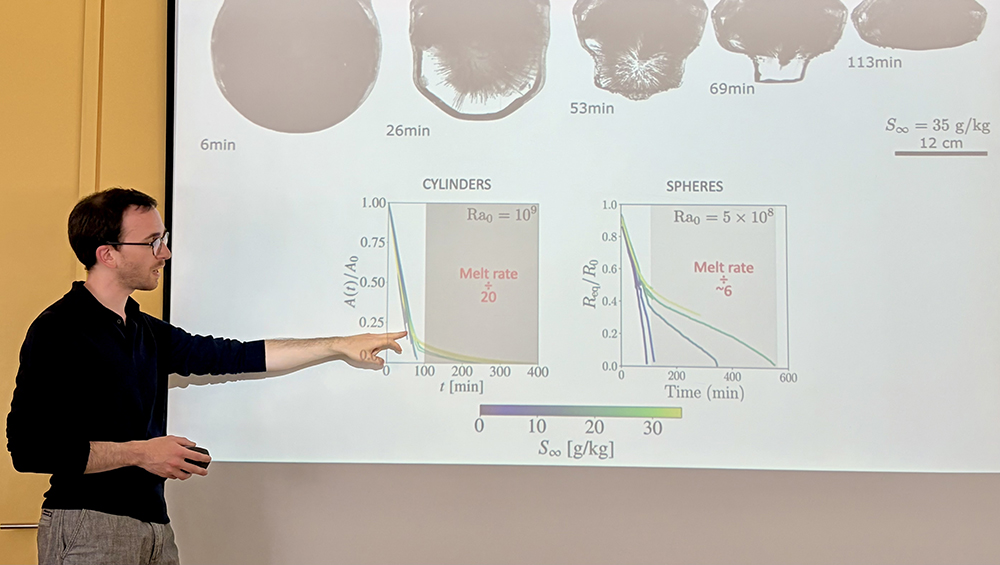
Constraining the key controls on ice melting in glaciers and the ocean is essential for climate models. Edoardo Bellincioni is a PhD student, currently working in the Physics of Fluids group at the University of Twente under the supervision of Sander Husiman and Detlef Lohse. During his PhD, Edoardo has been running laboratory experiments to

Water Masses of the Arctic from 40 Years of Hydrographic Observations

The Arctic Ocean has been changing rapidly in a warming climate. To monitor these changes, it is useful to classify the Arctic Ocean into water masses – bodies of water with similar origin and physical and biogeochemical properties.  However, there are significant barriers to Arctic water mass classification: observations of seawater properties are sparse, and

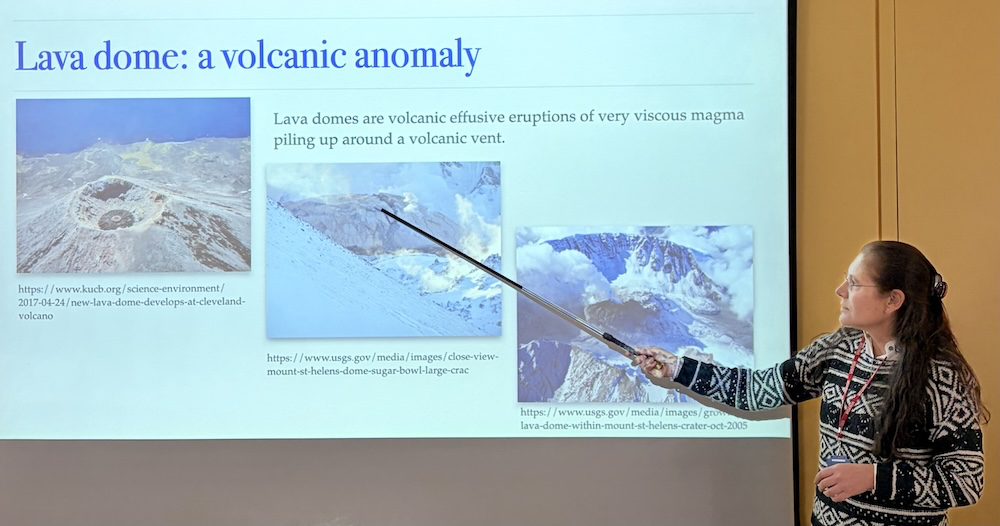
Forecasting volcanic eruptions

Volcanic eruptions threaten more than one in ten people worldwide, with the greatest risk at volcanoes reawakening after long quiescence. In these settings, eruptions are often explosive and nearby communities may be unprepared.  After obtaining his PhD at IEEF, Dr Eric Newland has been working on the NERC-funded project “FEVER: Forecasting Eruptions at Volcanoes after

Entrainment across turbulent interfaces

Turbulent flows are known to broaden with downstream distance, owing to the entrainment and mixing of ambient fluid into the flow. In the special case where the background is non-turbulent, the entrainment across the interface between the turbulent flow and the non-turbulent ambient is driven by viscous diffusion of the turbulent fluid into the ambient. 

Multiphase flows in volcanic systems

This week’s scheduled speaker, Angus Fotherby, was unwell and could not give the first seminar of the new year. We wish him a quick recovery and hope he will be able to return before the end of term to tell us about Chromium contamination and remediation in India. Today, professor Andy Woods discussed a number