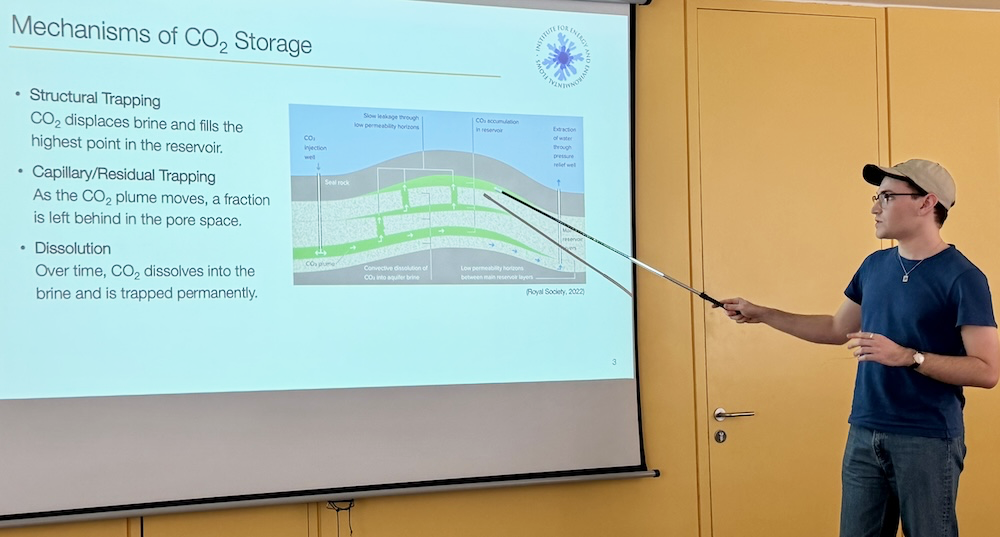
To ensure that the carbon dioxide captured during industrial processes is safely stored underground, it is essential to have a detailed understanding of the different mechanisms by which CO2 is trapped in geological aquifers. PhD student Ross Shepherd has been studying the long-term, post-injection fate of carbon dioxide in deep aquifers.
During today’s seminar, Ross explained that there are three key mechanisms by which CO2 becomes trapped in an aquifer: structural trapping, capillary/residual trapping, and dissolution into the surrounding formation brine. During his PhD, Ross has been developing new mathematical models of CO2 plumes as they migrate through the porous aquifer rock after the injection.
Ross uses pressure equations to characterise the behaviour of both the mobile CO2 plume and the capillary-trapped CO₂, and explores how variables such as the injection rate and the location of the well influence the long-term distribution of the CO₂ in the aquifer. His results show that the fraction of CO2 that becomes trapped is strongly sensitive to these parameters, with the greatest trapping occurring at high injection rates in wells located far from the reservoir crest.
Ross’ work is ongoing, and the results of his modelling will be published soon.