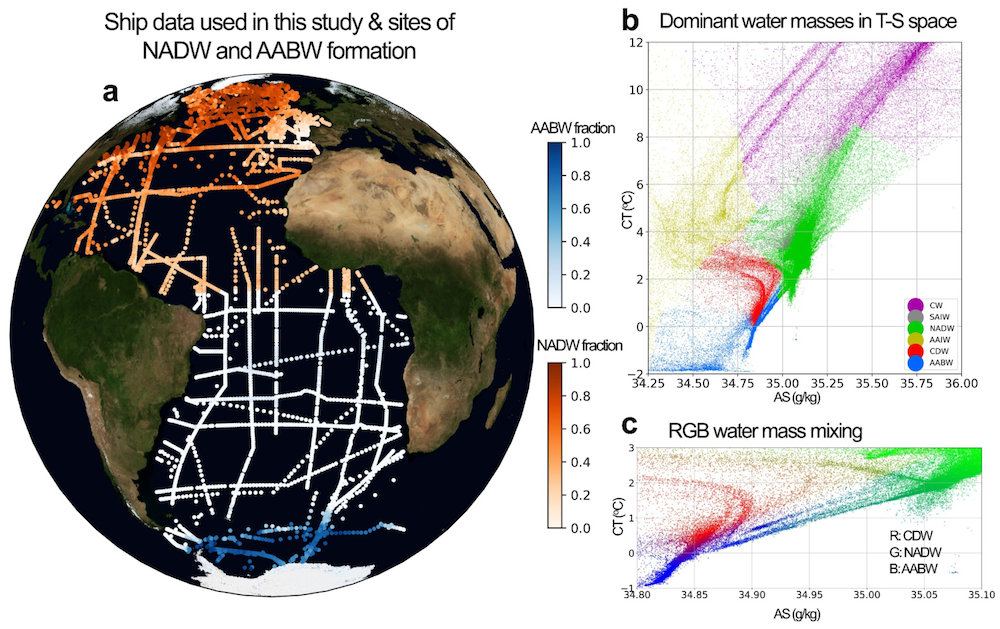
Water masses are large bodies of water with distinct properties. Identifying them helps us understand how the ocean moves, mixes, and transports heat, carbon, oxygen, and other properties. This usually requires detailed chemical measurements, which are typically only available in few sparse locations along ship tracks.
In a new study co-authored by Dr Ali Mashayek, a machine learning model is trained using those detailed measurements in the Atlantic Ocean. Once trained, the model can identify water masses using just temperature and salinity data that are much more widely available, enabling the mapping of water masses across the Atlantic Ocean at much higher spatial and temporal resolution.
The article, just published in JGR Machine Learning and Computation, applies this machine learning model to a data-assimilating ocean model to produce an estimate of the water mass distribution in the Atlantic Ocean every month between 1992 and 2018 and use it to infer changes in the water mass structure, theoretically enabling insights into AMOC variability and tipping points.