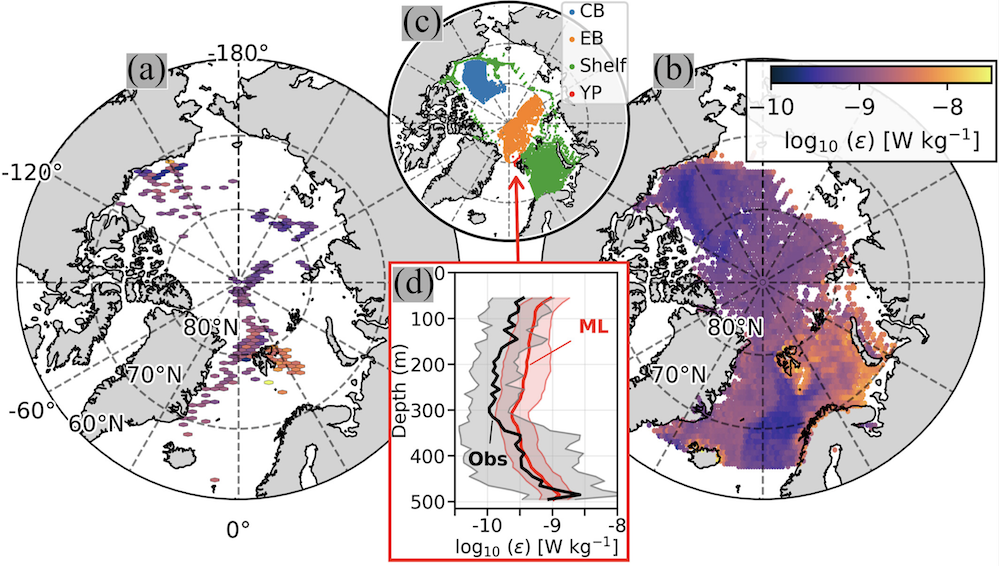
The Arctic Ocean has historically been ice-covered, shielding it from wind and resulting in weak currents and turbulence. With rapid sea-ice loss, the Arctic circulation is projected to accelerate, potentially enhancing turbulence, with important consequences. Turbulent mixing can bring heat from deep Atlantic-sourced waters toward sea ice and nutrients plentiful in deep waters to productive sunlit layers, affecting sea-ice dynamics, circulation, climate, and ecosystems. Understanding present mixing is critical for projecting future changes. However, measuring turbulence is expensive and challenging in the remote Arctic, leaving knowledge gaps.
In a new article recently published in Geophysical Research Letters and co-authored by professor Colm-cille Caulfield, a team of researchers have used machine learning (ML) to predict Arctic turbulence from much more widely observed, classical temperature and salinity profiles. The model presented in the article was trained on >5,000 global turbulence profiles, including Arctic data. Applied to pan-Arctic temperature and salinity observations, it predicts enhanced turbulence along margins and shelves and weaker values in basin interiors, consistent with current understanding. Applied to high-resolution model output, ML predictions show physically plausible patterns and more spatial variability than mixing schemes used in climate models, matching independent estimates of the mixing energy required to sustain Arctic overturning, with implications for heat and nutrient transport. The machine learning parameterisation can help assess climate-mixing feedbacks in projections while physics-based parameterisations mature.