Carboxylic acids like decanoic acid tend to pair up into two-molecule clusters called dimers when dissolved in liquids, held together by hydrogen bonds. Knowing how easily these pairs form or break apart is useful in fields such as corrosion prevention and carbon capture and storage, where single, unpaired acid molecules behave differently from paired ones.
A new article co-authored by Dr David Madden and Professor Stuart Clarke has been recently published in the Royal Society of Chemistry’s Physical Chemistry Chemical Physics journal. In this study, researchers tracked how decanoic acid pairs in pure cyclohexane, pure 1,4-dioxane, and mixtures of the two. They compared a standard Fourier-transform infrared (FTIR) spectroscopy technique against a newer method built around precise density measurements. Because paired and unpaired acid molecules take up slightly different volumes in solution, measuring density with high precision makes it possible to track how much pairing takes place.
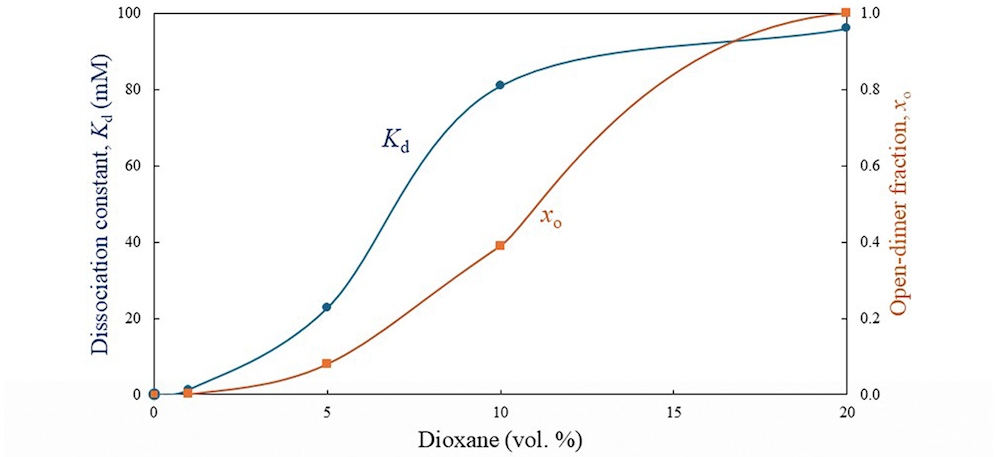
The two techniques gave closely matching results. Adding more 1,4-dioxane to cyclohexane steadily suppressed acid dimerisation. Dioxane’s greater polarity, quadrupolar character, and hydrogen-bond-accepting ability stabilise monomeric acid species via solute-solvent interactions, shifting the equilibrium away from self-association. In addition, the dimeric population transitioned from predominantly centrosymmetric, doubly hydrogen-bonded cyclic (“closed”) dimers in nonpolar cyclohexane toward singly hydrogen-bonded “open” dimers at higher dioxane fractions.