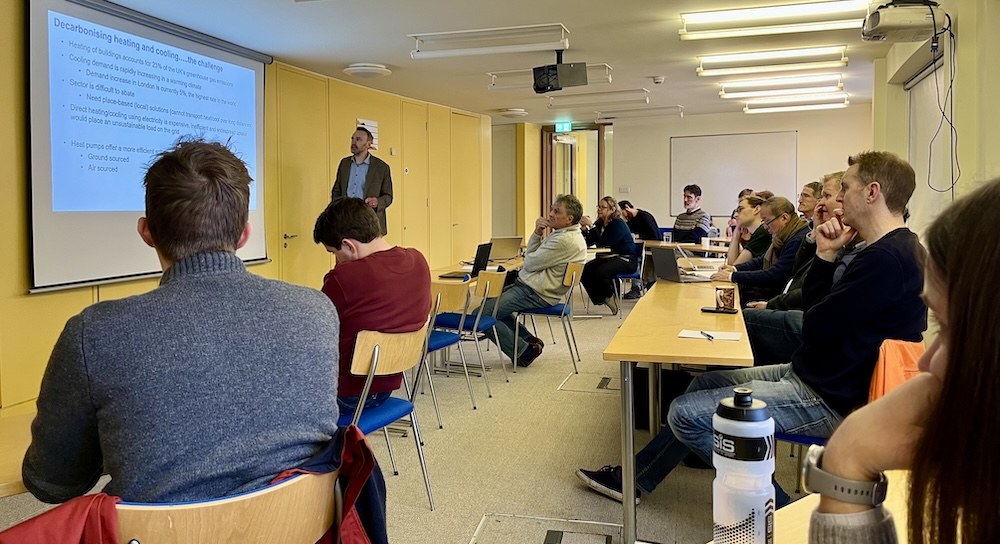
Professor Matthew Jackson from Imperial College London visited us today and presented his recent work on Aquifer Thermal Energy Storage (ATES) systems. This underground thermal energy storage technology provides large capacity, low carbon heating and cooling to the built environment. Heating and cooling of buildings currently produces 23% of the UK’s greenhouse gas emissions, and ATES can be a key technology for the UK to meet its net zero targets.
An ATES system uses two aquifers in the subsurface, which contain hot and cold water. During the warmer season, cold water is extracted from the cold aquifer and pumped to the surface. There, the water goes through a heat exchanger and is used to cool down a building. In the heat exchanger, the temperature of the water rises, and so the water is then pumped back underground to recharge the warmer reservoir. During the colder season, the process is reversed, and warm water is extracted from the warmer aquifer and used to heat up the building. As a result, the water becomes colder and is pumped back and stored into the cold reservoir.
Professor Jackson showed a number of examples of ATES systems which are currently in operation in the UK and overseas. These systems offer long-term sustainability and high heating and cooling efficiencies with low carbon emissions. Widespread deployment in the UK has potential to provide up to 16-41% reduction in carbon emissions for heating, and up to 86-94% reduction for cooling, compared to equivalent ground- or air-sourced heat pump systems.
A lot of work on aquifer thermal energy storage is also ongoing here at the Institute : you can read about two recent papers on the subject, here and here, and read the recent Royal Society report on Heat Storage co-authored by professor Woods.