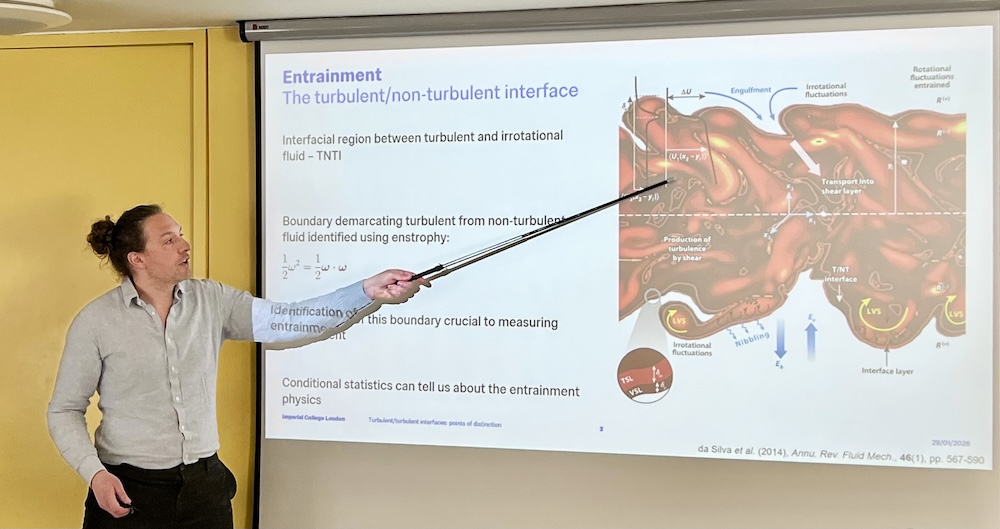
Turbulent flows are known to broaden with downstream distance, owing to the entrainment and mixing of ambient fluid into the flow. In the special case where the background is non-turbulent, the entrainment across the interface between the turbulent flow and the non-turbulent ambient is driven by viscous diffusion of the turbulent fluid into the ambient.
However, most environmental and industrial flows exist within a background that is itself turbulent. For example, wind turbines produce turbulent wakes, which develop within the turbulent atmospheric boundary layer. Professor Oliver Buxton and his research team at the Department of Aeronautics at Imperial College London have been studying the physics of entrainment across a turbulent/turbulent interface.
The turbulent nature of the background flow fundamentally alters the physics of entrainment. Professor Buxton has combined laboratory experiments and numerical simulations of the turbulent wake produced by a cylinder immersed in an ambient with grid-generated turbulence. These experiments have shown that when turbulence is added to the background, viscous action no longer is the only method by which enstrophy is transported to the background fluid.
In the presence of background turbulence, the surface area of the turbulent/turbulent interface increases. However, the net volume flux of ambient fluid which is entrained into the cylinder wake decreases as the intensity of the background turbulence is increased. Such reduction in the net entrainment rate is believed to be the result of the increased intermittency of the flow, which becomes characterised by large but infrequent detrainment events, leading to some fluid to be transported from the turbulent wake to the surrounding turbulent ambient.
Professor Buxton’s work on turbulent entrainment is ongoing, and you can read more about it here.
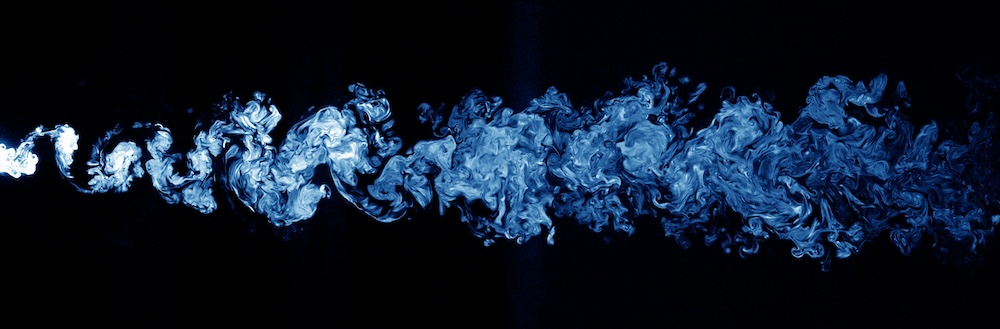
Turbulent wake produced by a cylinder, from Chen & Buxton (2023)