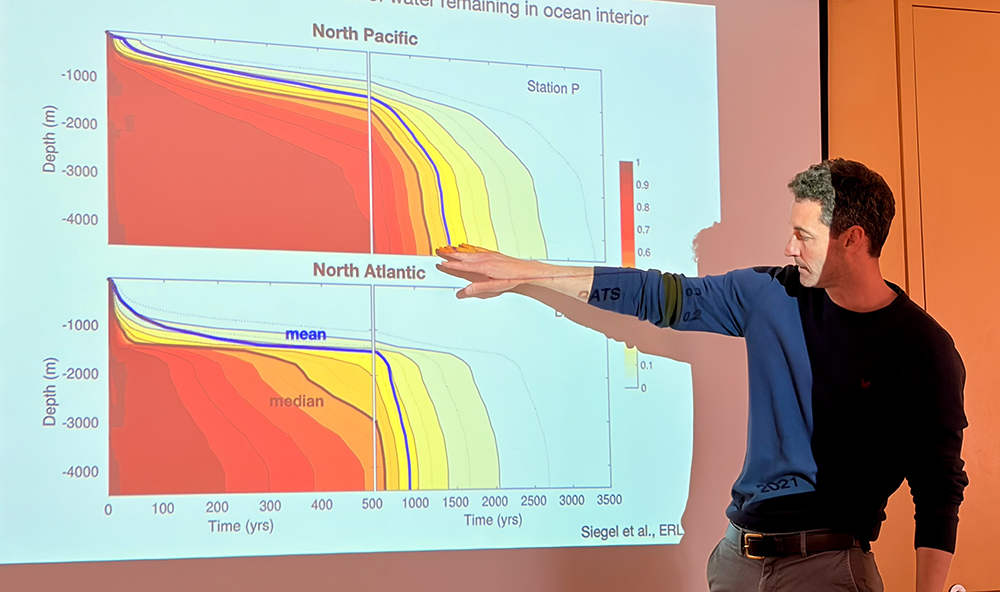
The ocean plays a central role in the global carbon cycle. Ocean water can absorb carbon dioxide from the atmosphere and sequester it at depth for hundreds or thousands of years. In fact, it is estimated that the deep ocean contains a massive reservoir of carbon, which dwarfs all other reservoirs combined (including vegetation, soil and fossil fuels).
Professor John Taylor, from the Department of Applied Mathematics and Theoretical Physics, has been studying carbon dioxide removal from the atmosphere via the ocean. This process is more effective at locations where the ocean currents initially drive water to the surface, where a large amount of CO2 is absorbed from the atmosphere, before letting it sink to the ocean depth, where the CO2 remains sequestered for hundreds of years before resurfacing.
At these locations, there may be an opportunity to implement strategies to enhance marine carbon dioxide removal. Professor Taylor has been investigating the impacts of growing macroalgae and kelp forests as a way of increasing the amount of carbon stored in the ocean. Macroalgae continually export carbon, both dissolved in the water and as particulate detritus through erosion and breakage. However, the interaction between the algae and the surrounding ecosystem is complex and not fully understood.
Professor Taylor and his team have built a new model which describes how the ocean water flows through a kelp forest and quantifies the transport and release rate of a saturating tracer (such as the nutrients required by the algae or the carbon released within the forest). Using a series of numerical simulations, they have identified the kelp density which maximises carbon release.
You can learn more about the work done by professor Taylor and his group on the Ocean Dynamics page, and read two recent articles on kelp farming here and here.