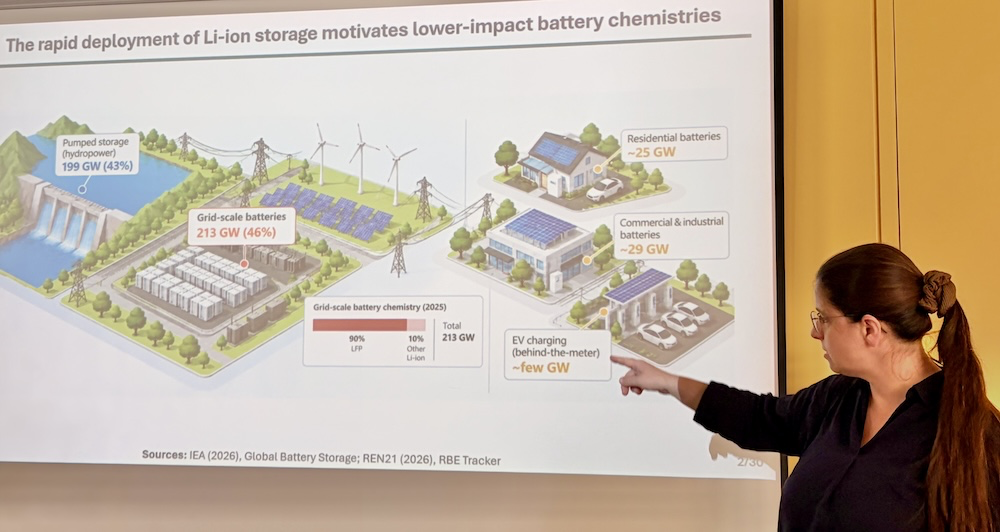
The rapid electrification of transport and the increasing demand for grid storage urge us to find alternatives to lithium-ion batteries, which rely on critical materials like lithium, nickel, and cobalt, raising significant supply and environmental concerns.
Dr Svetlana Menkin, from the Department of Chemistry, has been working on zinc-based batteries as a promising alternative for short- to medium-term energy storage. Zinc batteries offer inherent safety advantages, lower environmental impact, and avoid the use of critical materials. However, they currently face challenges related to low energy density and efficiency, primarily due to issues during the plating and stripping process, such as rough dendritic growth and hydrogen evolution.
Svetlana and her team are investigating the fundamental surface and interfacial processes that occur during zinc electrodeposition, including hydrogen evolution, corrosion, passivation, and the formation and evolution of interphases. These competing reactions can influence how zinc deposits, how charge is consumed, and how the electrode evolves during cycling.
Scanning electrochemical microscopy (SECM) provides a unique way to spatially resolve and monitor these processes in real time, allowing local electrochemical activity at the zinc-electrolyte interface to be directly linked to changes in electrode behaviour. Dr Menkin and her colleagues combine SECM with complementary electrochemical and spectroscopic approaches to identify the processes responsible for irreversible reactions and their impact on battery performance.
Across a range of battery-relevant electrolytes, hydrogen evolution has been found to decrease during cycling as the zinc surface and its interfacial chemistry evolve. Importantly, SECM measurements show that, under these conditions, hydrogen evolution accounts for only a small fraction of the irreversible capacity loss.
You can read more about the current research in the Menkin group here, and watch a short video interview with Svetlana here.