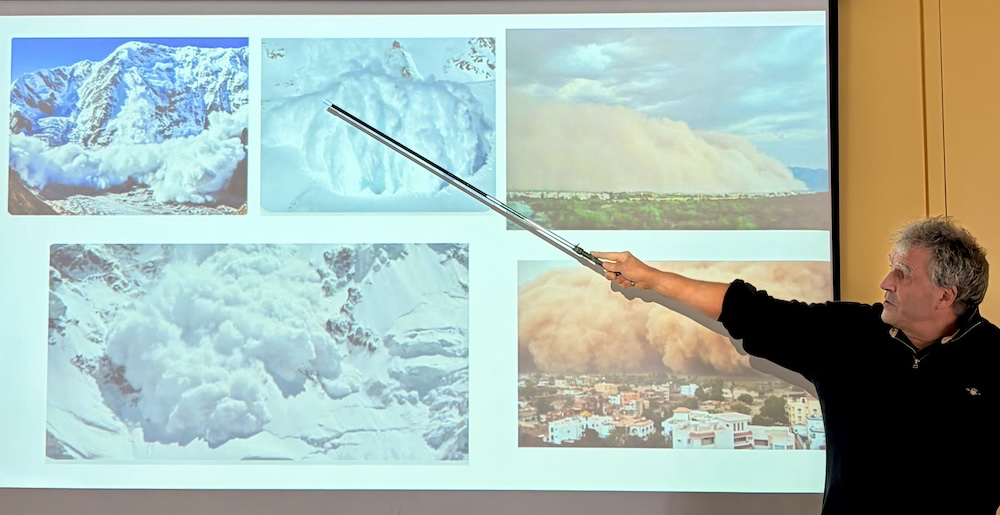
Gravity currents are flows driven by density differences between a fluid and its surroundings. These occur in various natural phenomena, such as volcanic ash flows, snow avalanches, and dust storms, as well as industrial applications like seabed mining. Over the years, much work has been done at the Institute to investigate the behaviour of these currents. In particular, numerous experiments have been designed to quantify the mixing of ambient fluid and the transport of particles within a current.
As a turbulent gravity current travels, it entrains and mixes with fluid from the surrounding ambient. This leads to an increase in the volume of the current, which becomes progressively more dilute. Currents resulting from a finite release of fluid, such as snow avalanches or volcanic ash flows, mix with the surrounding fluid differently than currents resulting from a steady source, such as continuous turbidity currents or river plumes.
If the current contains a suspension of heavy particles, these will gradually settle through the current fluid and eventually sediment out of the flow, leading to a change in the total buoyancy of the flow. The behaviour of the current will then be controlled by a combination of the time scales for mixing and sedimentation.
Understanding these processes is essential for hazard assessment, particularly in predicting the reach and impact of volcanic eruptions.
Our work on gravity currents is ongoing, and very recently a new paper on particle-laden currents was published in the Journal of Fluid Mechanics. New experiments are currently being run in the laboratory and we look forward to reporting about them soon.