The adsorption of molecules at solid-liquid interfaces is essential in applications such as adhesion, colloidal stabilisation, surface functionalisation, patterning, and tribology. While the properties of modified surfaces can be assessed under operating conditions, the underlying molecular-scale mechanisms can be difficult to determine. Nonetheless, it is important to understand how microscopic properties control macroscopic behaviour, so that new materials can be synthesised in an efficient and targeted manner.
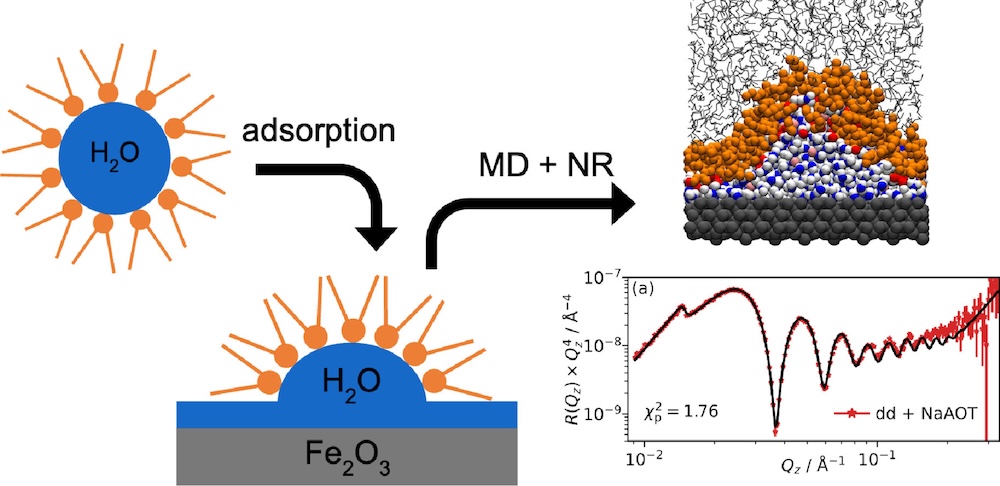
A new research article co-authored by professor Alex Routh has been recently published in the Journal of Colloid and Interface Science. In this work, a combination of neutron reflectometry experiments and molecular dynamics simulations are used to investigate the self-assembly and adsorption of Aerosol-OT (AOT) and water at the dodecane/iron-oxide interface.
AOT is an anionic surfactant which self-assembles in non-aqueous solvents to form reverse micelles, and this is enhanced by the addition of polar molecules which localise in the cores of the reverse micelles. The experiments and simulations presented in the article show that water is strongly adsorbed onto the surface, and that the AOT is localised between the water layer and the bulk dodecane. The water layer is not of uniform thickness, but rather it is drawn up into the interiors of AOT hemimicelles. Direct comparison of the measured and computed neutron reflectivity and scattering length density show good consistency: this gives confidence in the molecular-scale picture drawn from the simulations, and demonstrates that the combination of experimental and computational approaches gives crucial insights on technologically important formulations.
You can read the full paper here.