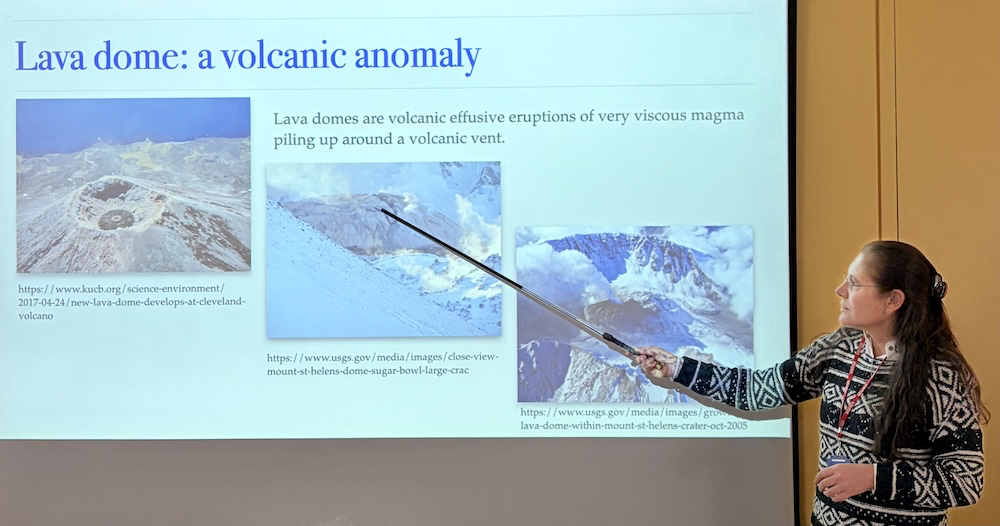
Lava domes typically form during the eruption of highly viscous lava from a volcanic vent. Due to its high viscosity, the lava spread relatively slowly over a limited spatial area. Nevertheless, lava domes pose a lethal risk, as they can explode or undergo cyclic collapse, generating pyroclastic flows.
In 1982, a theoretical model was developed which uses lubrication theory to derive an analytical solution for a gravity-driven viscous flow from a point source. This model was successfully applied to the growth of lava domes.
Professor Catherine Meriaux, from the East African Institute for Fundamental Research of the University of Rwanda, has developed a new model which moves beyond the point source solution and examines how the growth of a lava dome is influenced by the vent geometry and the vent-feeding conditions.
Using numerical simulations, professor Meriaux examines how the vent geometry determines different dome spreading regimes. She also investigates how the effusion rate influences the strain rates and stresses at the vent and in its vicinity, with implications for lava dome failure. You can read about professor Meriaux’s work on lava domes here and find out more about her work at EAIFR here.