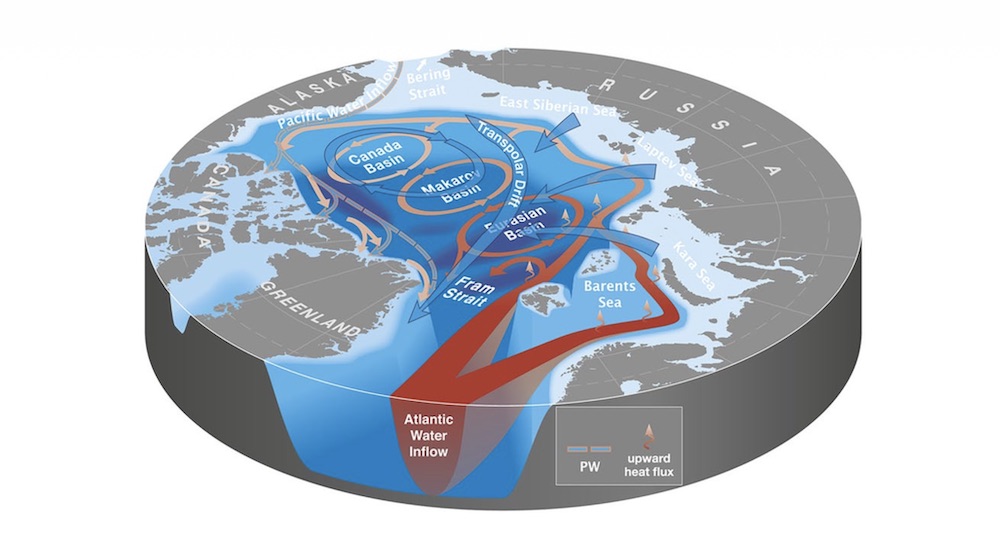
The Arctic Ocean has been changing rapidly in a warming climate. To monitor these changes, it is useful to classify the Arctic Ocean into water masses – bodies of water with similar origin and physical and biogeochemical properties.
However, there are significant barriers to Arctic water mass classification: observations of seawater properties are sparse, and traditional classification relies on extensive knowledge of water mass characteristics and circulation.
To address these challenges, a new article recently published in Scientific Data and co-authored by Professor Colm-Cille Caulfield and Dr Ali Mashayek compiles existing hydrographic observations of the upper 1000 m of the Arctic Ocean and classifies these observations into water masses.
The article presents the classification tool and accompanying dataset, Water Masses of the Arctic (WMA), to support basin-wide investigations of Arctic Ocean circulation, its variability, drivers and impacts on wider Arctic climate. This dataset reproduces key spatial and temporal features of Arctic water masses, including Atlantic and Pacific Water pathways. The WMA dataset will improve understanding of Arctic Ocean dynamics and provide an accessible framework for assessing the accuracy of the representation of the Arctic Ocean in Earth System Models.