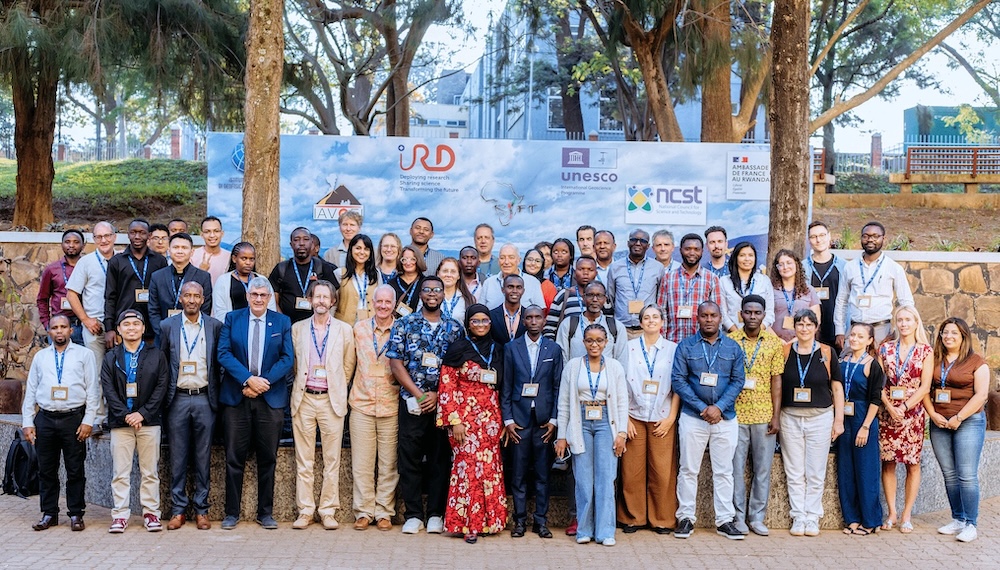
The interdisciplinary study of volcanic processes requires a multitude of approaches, ranging from analogue and numerical modelling to observations and fieldwork and extending to mathematics. In September 2025, a conference was held at the East African Institute for Fundamental Research in Kigali, affiliated with the University of Rwanda, a country which, along with the Democratic Republic of Congo, presents a unique geodynamic context. Located along the East African Rift, a region of active seismicity, Rwanda is close to two of Africa’s most active volcanoes. One of them, Mount Nyiragongo, overlooks Lake Kivu, a deep volcanic lake rich in dissolved carbon dioxide and methane, currently used for electricity generation. Professor Woods was among the attendants and speakers at the conference and his group at the Institute is currently studying the fluid dynamics of power generation at Lake Kivu.
The Kigali conference addressed many “classic” volcanological topics and their modern advances, such as multiphase lava flows, subsurface magma propagation, seismic and deformation signals from a volcano, modelling of volcanic emission dispersion, and volcanic lakes. Yet, it broadened the discussion to the volcanic particle-water interface and its impact on soils, volcanoes and climate change, and volcanoes and health. A new article has recently been published in Bulletin of Volcanology and aims to highlight and share the richness of the integration and interconnectedness of the various questions related to a volcanic environment, as well as their impact on society.