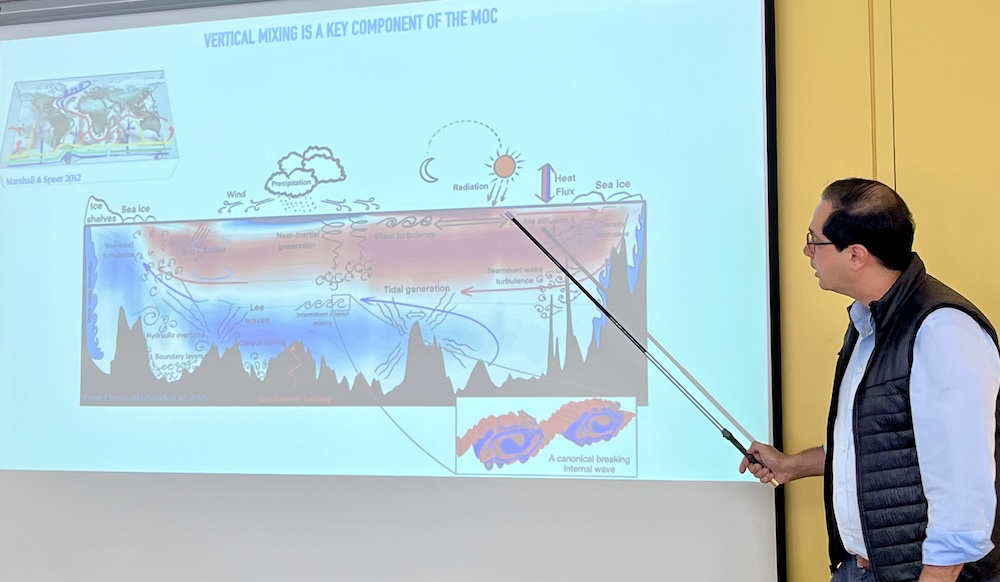
Deep ocean water contains a very large reservoir of carbon, and so understanding how this water moves and mixes over time is essential for all climate models. Over the last few decades, observations have shown that passive tracers initially located in the deep ocean have gradually resurfaced, suggesting that there are pathways through which deep water is mixed and recirculated within a basin.
However, the balance of processes underpinning the mixing is still subject to significant uncertainties. There are a number of different energy sources which might result in ocean mixing, including wind, tides, and geothermal heating through the seafloor: but, with limited observation available, little is still known about their relative large-scale impact.
When the deep ocean water flows through rough topography, vortices are generated, which may produce significant mixing. Dr Ali Mashayek has recently been studying these vortices, with the aim of characterising the role of seamounts in ocean upwelling.
The vortices shed in the wake of a seamount will produce some degree of layering in the surrounding density-stratified ocean water, and this will vary depending on the Rossby and Froude numbers associated with the flow. Using a state-of-the-art global seamount census, Ali has estimated to leading order that the amount of mixing produced by deep ocean flows impinging on seamounts is non-negligible compared with that produced by tidal flows. The impact of seamounts varies in different basins and at different latitudes, and more work will follow to investigate it in greater detail.
You can read more about this research in a recent paper published in PNAS, and read about Ali’s work in the Climate Research, Environmental Solutions & Technology Lab here.