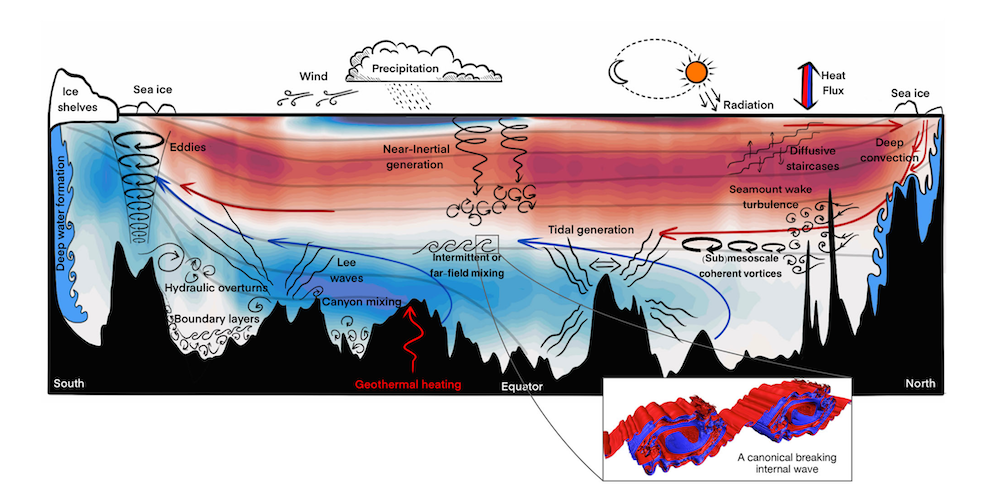
Small-scale turbulent mixing in the ocean interior is vital in governing ocean circulation and tracer distributions, and hence global climate. However, the planetary extent of this role and its dependence on the microphysics of mixing remain inadequately understood.
A new article published in Nature Communications and co-authored by professor Colm Caulfield emphasises the variety of spatio-temporal scales on which such interior turbulent mixing can shape the climate system. In addition to its well-established role in facilitating the equilibration of deep branches of ocean circulation on centennial-to-millennial timescales, interior turbulent mixing is a leading determinant of oceanic tracer budgets on timescales as short as sub-annual.
The paper highlights the importance of the co-dependence of vertical (diapycnal) mixing and lateral (isopycnal) stirring in establishing the large-scale impacts of oceanic turbulence; it presents a summary of theoretical, observational and computational bottlenecks in the way of a sufficiently accurate representation of mixing in Earth System Models; and discusses emerging opportunities for making progress in these areas.