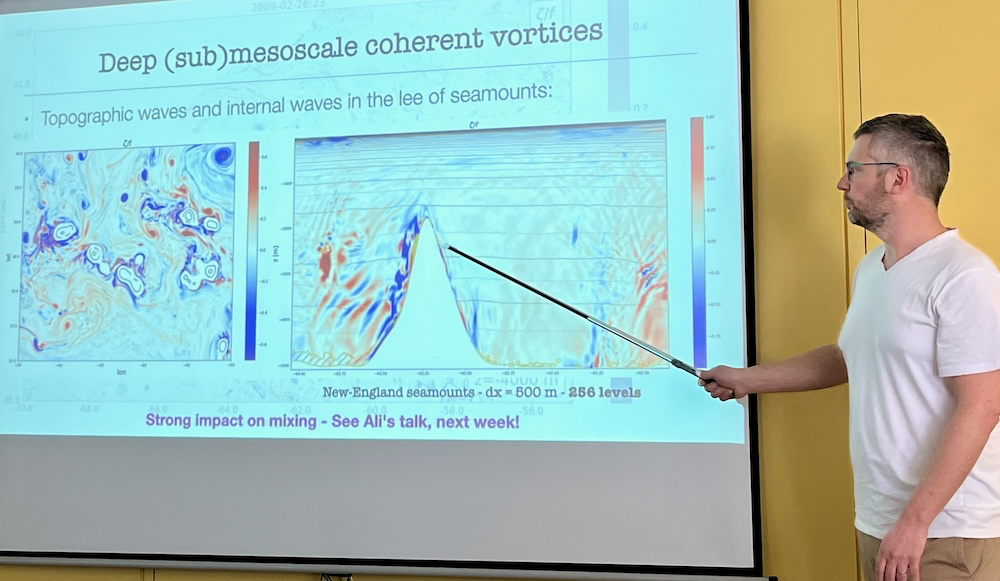
Numerical modelling is a key tool for understanding deep ocean dynamics, where observations remain sparse, particularly at submesoscales (1–30 km). Jonathan Gula, from the Laboratoire d’Océanographie Physique et Spatiale, Université de Bretagne Occidentale, uses high-resolution basin-scale and regional simulations to investigate how interactions between currents, topography, and mixing shape abyssal circulation and tracer transport.
During today’s seminar, Dr Gula examined the generation of long-lived submesoscale coherent vortices (SCVs), which transport tracers and momentum isopycnally from boundary regions into the basin interior, contributing to lateral exchange. The largest among these vortices can be of size up to hundreds of metres in height and tens of kilometres in width, and they can be partially detected by their hydrographic anomalies; however, little is currently known about the smaller vortices, or the ones with weak anomalies, particularly when located at depths larger than 2000 m.
To learn more about these vortices, Dr Gula has developed a hierarchy of realistic simulations of the ocean at the basin scale, with horizontal resolution as small as 1 km. One of these simulations, called GIGATL, focusses on the Atlantic Ocean, and can be used to do quantitative statistical observation of the flows in the Atlantic basin. The model shows that in the region near Gibraltar most cyclonic eddies get destroyed near their generation site, strained by anticyclones. Conversely, anticyclonic eddies grow by merger: these can then live for years and propagate long distances, sometimes even crossing the mid-Atlantic ridge.
You can read more about Dr Gula’s work on his personal website here, and find more information about the GIGATL project on GitHub here.
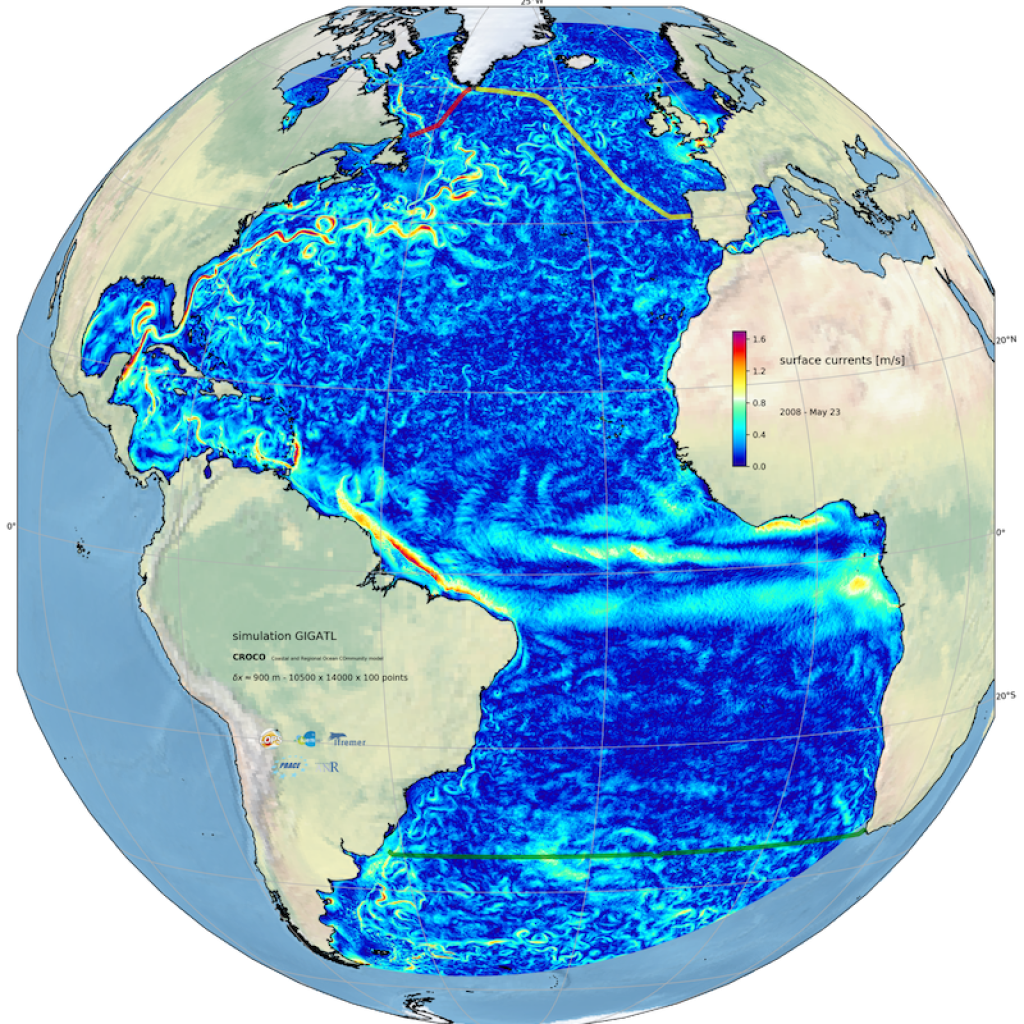
Surface current speed as modelled in GIGATL