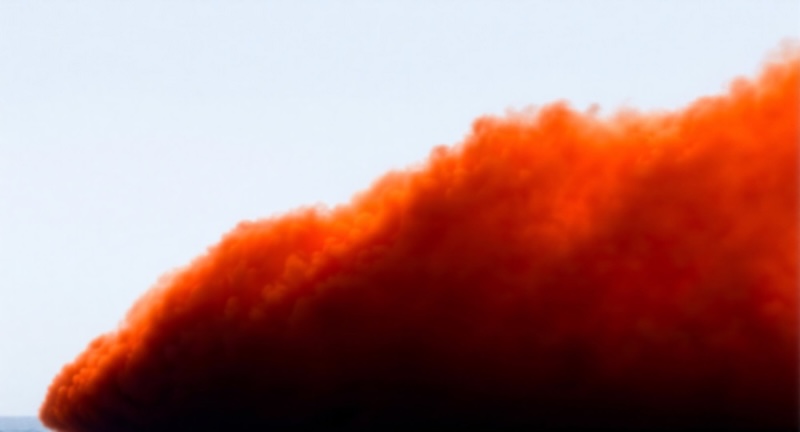
Particle-driven gravity currents arise in many situations in nature and industry, including large turbidity currents that spread up to hundreds of km over the sea floor, volcanic ash flows that travel tens of km from volcanic vents, and particle suspensions produced during deep-sea mining operations. Much research into the dynamics of these flows has been carried out at the Institute in recent years.
A new paper by Shungo Tonoyama and professor Andy Woods has just been published in the Journal of Fluid Mechanics. The paper presents the results of new laboratory experiments designed to characterise the entrainment and mixing in particle-driven, finite-volume gravity currents.
The new experiments show that some of the ambient fluid displaced up and over the head of a current becomes mixed into the current. Measurements show that this leads to an increase in volume of the current at a similar rate to that in a single-phase current. The experiments also show that particles gradually settle from the top surface of the current, releasing fluid from the current. Eventually, this begins to dominate the entrainment through the head, and the volume of the current then decreases. Meanwhile, particles continuously sediment from the base of the flow, reducing the particle load.
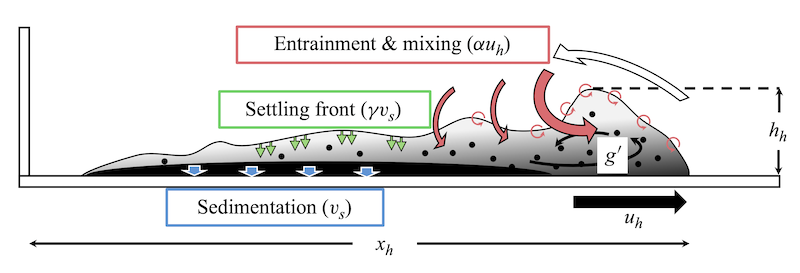
Shungo and Andy have developed a simplified integral box model which illustrates the evolving balance between these processes. The model combines the entrainment law proposed by Sher and Woods (2015) for single-phase gravity currents, the sedimentation law proposed by Bonnecaze et al. (1993) for a constant-volume gravity current, and a new model for the release of fluid from the top surface of the current through particle settling.
Estimating the amount of fluid entrained and mixed into a current is crucial, especially where the effects of fluid entrainment can lead to a change in fluid chemistry, promoting flocculation and hence sedimentation, or a change in fluid buoyancy through fluid-particle interaction.