Electrochemical splitting of water to generate hydrogen as a fuel is one of the important possible approaches to replace fossil fuels. Demand for hydrogen is increasing rapidly owing to its various applications in the chemical industry, transportation, and power sectors. Hydrogen is also essential to decarbonise major industrial processes such as the Haber-Bosch ammonia synthesis and steel production, which otherwise would have enormous carbon dioxide emissions.
Splitting of water into hydrogen and oxygen is an endothermic reaction which involves two half reactions: the hydrogen evolution reaction (HER), which occurs at the cathode, and the oxygen evolution reaction (OER), which occurs at the anode. Of these two half-reactions, the OER is found to have a higher overpotential attributed to the numerous electron transporting steps and formation of the oxygen-oxygen bond, while the HER is relatively facile. Consequently, the focus of electrochemical water splitting work is designing better OER electrocatalysts.
To date, noble-metal-based materials, especially Ir- and Ru-based oxide electrocatalysts, have been widely preferred; however, their large-scale application in hydrogen production is limited due to high cost and supply constraints. Hence, a number of non-precious-metal-based electrocatalysts are being designed, with the aim of identifying viable alternatives.
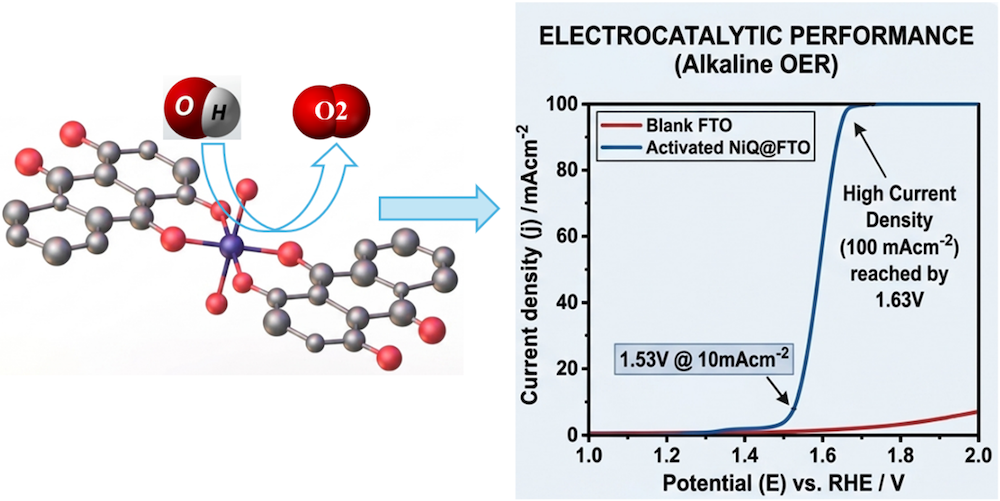
A new article, recently published in the New Journal of Chemistry and co-authored by Dr Rafia Nimal and Professor Stuart Clarke, presents the first systematic study of a metal coordination compound (MCC) based on nickel and 1,4-dihydroxyanthraquinone (quinizarin) as an OER catalyst.
The nickel-quinizarin complex (NiQ) was synthesised using a facile solvothermal route and a crystalline product was obtained that exhibited excellent structural integrity. The article discusses the structural properties of the NiQ crystals, as well as their redox and electrocatalytic performance. Drop casting of NiQ slurry on FTO coated glass plates, with no additional binders or conducting particles, achieved an overpotential as low as 300 mV at 10 mA cm−2, surpassing those of many previously reported coordination complex-based OER catalysts. Furthermore, it demonstrated excellent stability over prolonged electrolysis with no significant degradation.
You can read the full paper here, and also read more about the Institute’s work on catalyst design for OER and on the fluid dynamics of hydrogen electrolysis.