Lake Kivu is located on the border of Rwanda and the Democratic Republic of Congo, along the western branch of the East African Rift, a region of active volcanism and high seismicity. The lake deep waters contain nearly 60 cubic km of methane and over 300 cubic km of carbon dioxide. The methane can be extracted for electricity production: the amount of methane dissolved in the lake would be sufficient to provide a very significant fraction of the power used in the region for the next 50-100 years.
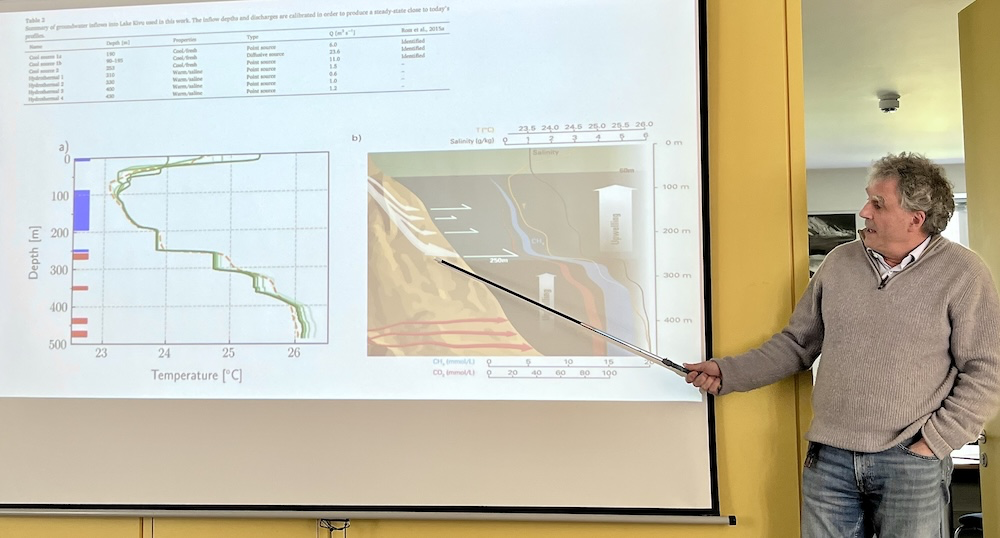
During today’s seminar, professor Andy Woods presented the first results of a new, UKRI-funded research project on the water flows following methane extraction in Lake Kivu.
Recent surveys have shown that the lake water is strongly stratified, with most of the methane and carbon dioxide being dissolved at depth. Water in the top 50-100 m below the surface contains a fishery, which is essential for the nearby population and should be preserved. Hence, a detailed understanding of the flows which develop in the lake is needed to ensure that the shallow water is not affected by the methane extraction activity, and that the deep, methane-rich water is not mixed and diluted unnecessarily.
Furthermore, there are concerns associated with the activity of Mount Nyiragongo, an active volcano located just a few kilometres north of the lake. If a sudden eruption produced a fissure that reaches the lake, then a plume of hot water might develop in the lake, potentially leading to a major release of the dissolved gases. In the coming months, small-scale analogue laboratory experiments will be carried out at the Institute, to investigate the risks and likelihood of such a lake overturning event.
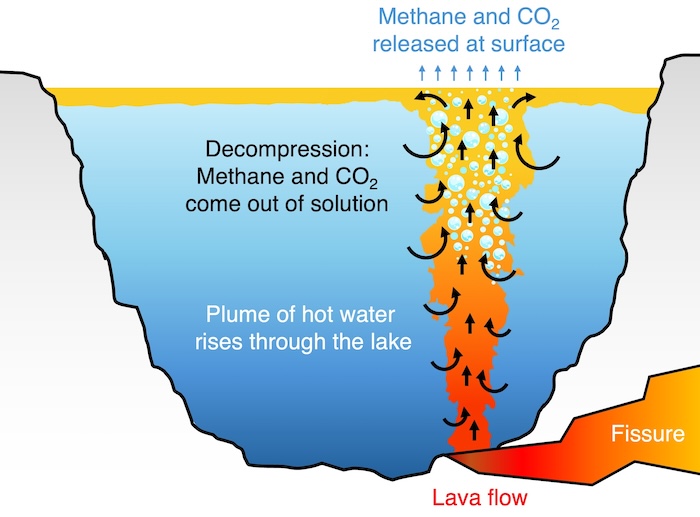
Schematic illustration of a thermal plume developing in the lake as a result of an eruption of the nearby volcano