Green hydrogen is generated by splitting water molecules through electrolysis and producing it using electricity from renewable sources is crucial for transitioning to a net-zero economy. Proton exchange membrane (PEM) electrolysers are leading technologies for this process. Central to these systems is the oxygen-forming reaction, which demands strongly acidic conditions. This step, where water molecules split to produce oxygen gas at the anode, has long been a bottleneck for green hydrogen production.
Iridium oxide is one of the few materials that remains both active and stable in such acidic environments. However, iridium is a rare element and its limited global supply presents a significant barrier to scaling hydrogen production. To achieve terawatt-scale green hydrogen production, iridium must be used more efficiently, or potentially be replaced by a different, more abundant material.
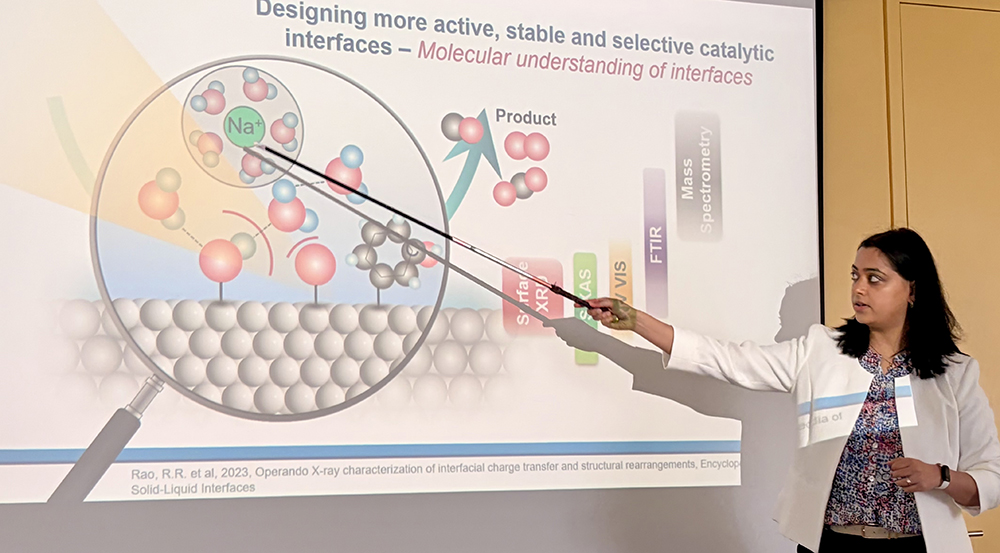
Dr Reshma Rao is a Royal Academy of Engineering research fellow at the Department of Materials, Imperial College London. Her research group at the Grantham Institute is working to get a deeper understanding of how the current state-of-the-art catalysts function at the atomic scale during operation, with the goal of accelerating the discovery of more sustainable, resilient, and earth-abundant catalytic materials.
To achieve this goal, Dr Rao uses a combination of optical spectroscopy, X-ray techniques and electrochemical mass spectrometry to reveal the physical and chemical processes occurring at the catalyst interface with nanometer-scale resolution. This provides a clearer understanding of the active surface states, which may help develop improved materials for green hydrogen production.
You can read more about Dr Rao and her work at Imperial here and here.