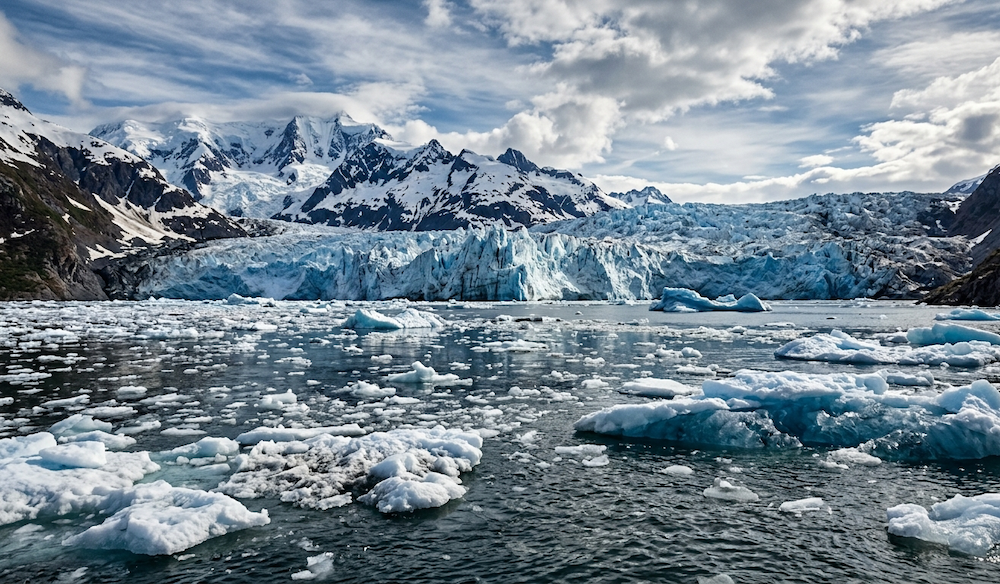
Over the last few decades, several marine-terminating glaciers in Greenland and Antarctica have retreated. Submarine melting of the calving glacier fronts is thought to be one of the dominant drivers of this retreat. In fact, for ice floating on seawater, the volume loss below the surface can be several times larger than the loss due to solar radiation and wind erosion above the surface. This happens because the floating ice and the surrounding seawater are coupled: the convective flow of relatively mild ocean water enhances the melting of the ice, which in turn leads to a reduction in the water temperature, resulting in faster buoyancy-driven convection. Understanding the key controls on floating ice melting is therefore essential for climate models and sea-level rise predictions.
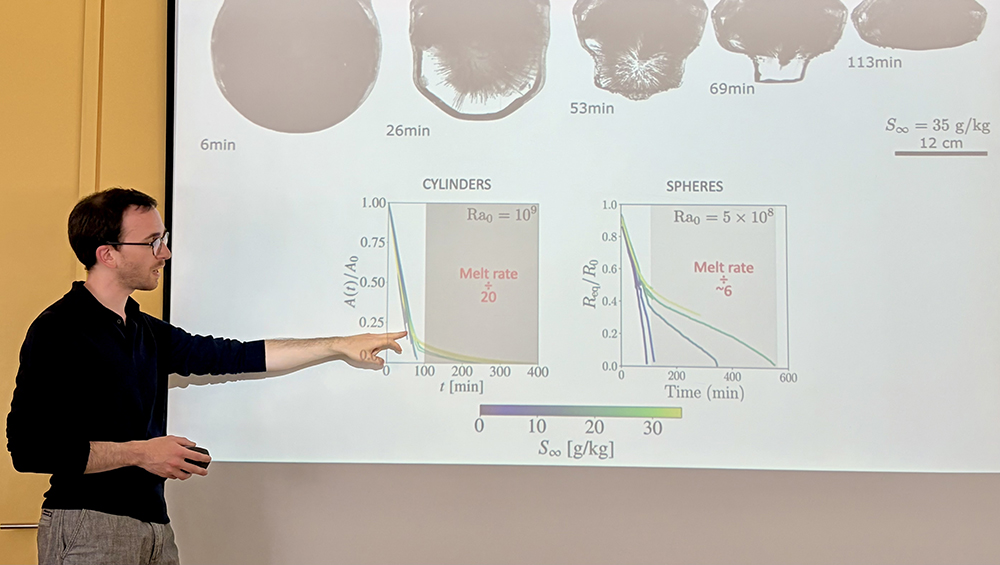
Dr Quentin Kriaa and his colleagues Swen van den Heuvel, Tolga Emir, Sander Huisman and Detlef Lohse from the University of Twente have developed new laboratory experiments to investigate the melting of a floating block of ice in quiescent saline water. Using blocks of varying geometry in both open and confined configurations, and allowing for the block to be either freely moving or fixed, they have explored how salinity, geometry and confinement control melt rates, local circulation and the emergence of morphological instabilities at the ice-water interface.
Quentin’s experiments show that the buoyancy-driven flow which develops at the boundary between the ice and the ambient water can be either controlled by differences in temperature or salinity, leading to different melting patterns and rates. When a block melts in a confined space, such as a closely-packed ice mélange in a glacier fjord, fresh buoyant water may accumulate at the surface, forming a stratified environment where the ice partially self-insulates, leading to delayed melting.
A new paper illustrating the key findings of this research is currently under review, and we will report about it as soon as it is published. You can read more here about the research on melting of ice and glaciers which is ongoing in Twente.